• PREFACE
  • CREDITS

Pier 59 (White Star Lines) on West 18th St.
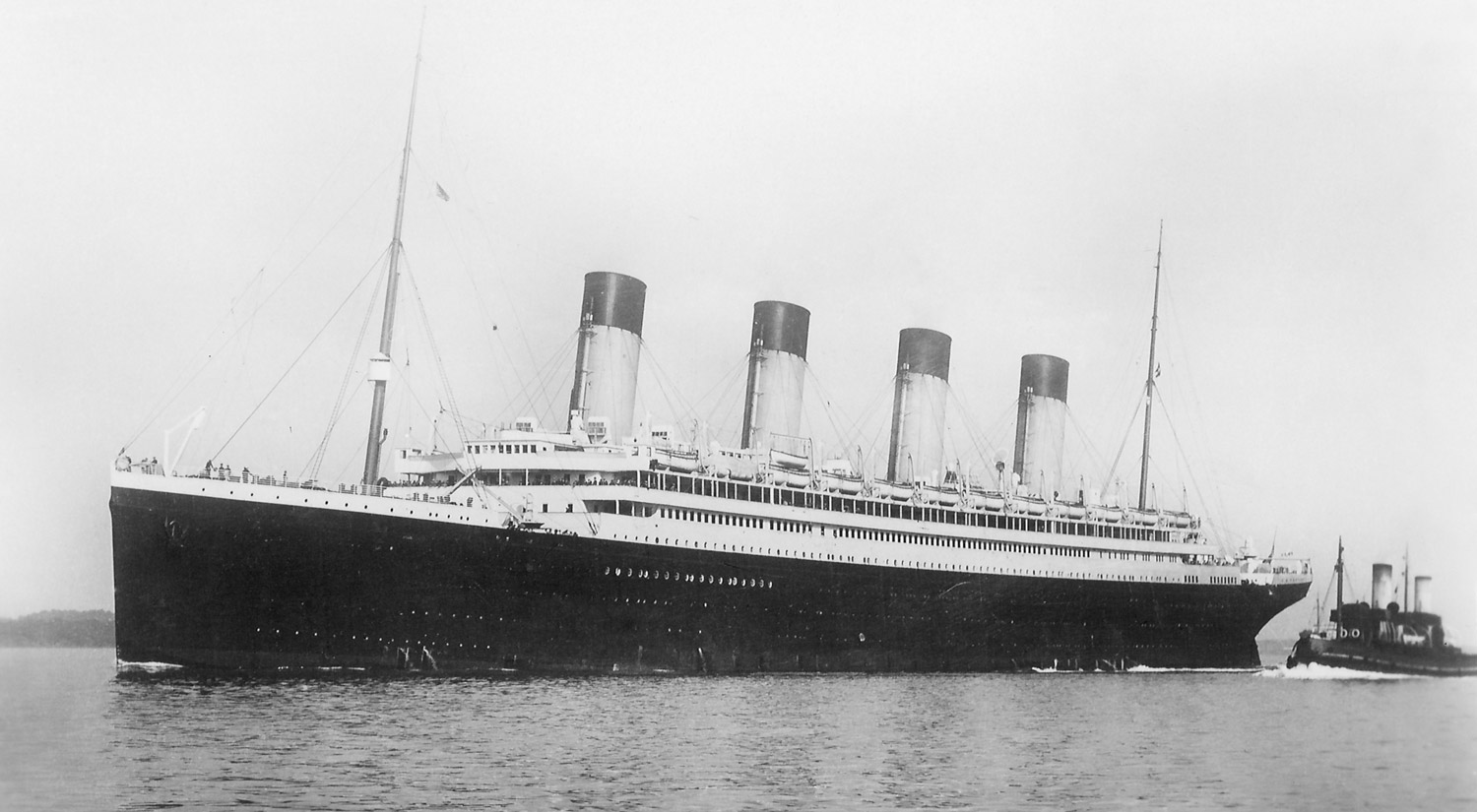
García Lorca and his friend and mentor Fernando de los Ríos took the RMS Olympic--sister ship of the Titanic--from Southampton to New York, arriving on June 25, 1929. Lorca wrote his parents that his trip had been marvelous. "The ocean was completely calm for all six days. They were like six days in a sanatorium and I have gotten a real tan, as black as blackest Africa. Life on board a ship is quite gay, and people confide in each other right away. . . .When the ship docked, I had a great surprise. A group of Spaniards was there waiting for us.
Ángel del Río, the professor Federico de Onís, the poet León Felipe, various journalists, the director of La Prensa and-- brace yourselves!-- Gabriel García Maroto, who went crazy hugging and even kissing me . . . " (Letter to his parents, June 28, 1929.)

Passenger manifest from RMS Olympic

Passenger manifest from RMS Olympic (ancestry.com), showing García Lorca and Fernando de los Ríos

Fernando de los Ríos. Fundación Federico García Lorca

García Lorca traveled to New York in the company of Fernando de los Ríos, who had been his professor at the University of Granada and who had persuaded his parents to allow him to study English at Columbia University (De los Ríos had been a visiting professor there the year before.) It was a "delightful voyage," the poet wrote his parents on June 28, 1929, "an easy one thanks to Don Fernando, who was so kind to me that everyone took him for my father. One cannot imagine a more affectionate, solicitous person, and you should all feel grateful to him."

Pier 8, East River, Foot of Old Slip, New York City

New York Public Library Digital Gallery

On the morning of June 18, 1930, on his return voyage to Spain, after having spent three of the happiest months of his life lecturing in Cuba, FGL arrived at a pier at the foot of Old Slip, on the Manuel Arnús (Spanish Royal Mail Line), and was met by friends, among them, Herschel and Norma Brickell.

"We went aboard the ancient liner, full of a weird assortment of smells, to have luncheon . . . [after which] Federico, dressed in a wrinkled linen suit, and having gained too much weight in Cuba, played on an old and battered upright piano, which showed that it had survived storms at sea, and worse. He played and sang a song he had written especially for Norma, my wife, and as we walked off down the dock he called to her to say he would shortly send her the manuscript copy, autographed... He waved goodbye with his small, clever hands, the Spanish good-bye that says 'Come back soon,' and we went off home thinking of the many happy hours we had spent with Federico." (Herschel Brickell, "A Spanish Poet in New York")

East River. Shore and skyline of Manhattan between East 35th and 42nd Streets: Williamsburg and Queensborough Bridges. Visible are Chanin Building, Chase National Bank, and Chrysler Building. 1930

New York Library Digital Gallery

Lorca's poem "Ode to Walt Whitman," which begins with a mention of the East River, pictures the great American poet as a savior of the American values threatened by the evils of capitalism.

From "Oda a Walt Whitman"

Nueva York de cieno,
Nueva York de alambres y de muerte.
¿Qué ángel llevas oculto en la mejilla?
¿Qué voz perfecta dirá las verdades del trigo?
¿Quién el sueño terrible de tus anémonas manchadas?

New York, mire,
New York, wires and death.
What angel are you hiding in your cheek?
Whose perfect voice will speak the truths of wheat?
Who, the terrible dream of your stained anemones?

General view of Lower Manhattan. (1930)

New York Public Library Digital Gallery

From "Navidad en el Hudson"

Lo que importa es esto: hueco. Mundo solo. Deesembocadura.
Alba no. Fábula inerte.
Sólo esto: desembocadura.
Oh esponja mía gris.
Oh cuello mío recién degollado.
Oh río grande mío.
Oh brisa mía de límites que no son míos.
Oh filo de mi amor, oh hiriente filo.

Christmas on the Hudson", Poet in New York

"What matters is this: emptied space. Lonely world. River's mouth.
Not dawn. Idle fable.
This alone: river's mouth.
Oh, my gray sponge!
Oh, my throat just cut open!
Oh, my great river!
Oh, my breeze's boundaries that are not mine!
Oh, the keen blade of my love, oh, the cutting blade! (Tr. Simon & White)

Columbia University, Furnald Hall Room 617

Private collection

In a vain attempt to get him to learn more English, the poet's friend Columbia Professor Federico de Onís insisted Lorca live in a dormitory rather than in Columbia's International House. From room 617 Furnald Hall, the poet wrote his family:

The University is prodigious. It is located on the bank of the Hudson River, in the heart of the city, on the island of Manhattan, which is the best part, and is very close to the great avenues. And yet it is delightfully calm and quiet. My room ... overlooks the huge sports fields, with their green grass, and statues. To one side, below the windows of the rooms just across the hall, is Broadway, the immense boulevard that runs from one end of New York to the other. It would be foolish to even try to describe the immensity of the skyscrapers and the traffic. Everything I could say would fall short. All Granada would fit into three of these buildings." (Letter to his parents, 28 June, 1929)

Double Exposure: Lorca and Ángel del Río in New York park, probably in Central Park, 1929

Fundación Federico García Lorca

Double exposure of Federico García Lorca and Columbia professor and friend Ángel del Río, probably in Central Park, 1929. In the foreground is Del Río's son Miguel Ángel. (Fundación Federico García Lorca)

2294 Seventh Avenue: Smalls Paradise nightclub

The American Negro, Annals of the American Academy of Political and Social Science, 1928

Influenced by thinkers like Herman Keyserling, whose book America Set Free (1928) he seems to have read in Spanish on returning to Spain, Lorca declared that African Americans were "the most spiritual element" in an otherwise soulless U.S. ". . . Any visitor can easily see that, for all their ebullience, they yearn to be a nation, and even though they occasionally make theater out of themselves, in the depths of their spirit they are incorruptible." In one cabaret—Smalls Paradise—whose dancing audience was as black, wet, and grainy as a tin of caviar, I saw a naked dancer shuddering convulsively under an invisible rain of fire. But while everyone shouted as though believing her to be possessed by the rhythm, I stared into her eyes and, just for a second, felt her reserve, her remoteness, her inner certainty that she had nothing to do with that admiring audience of Americans and foreigners. All Harlem was like her." (Lecture, "A Poet in New York")

Harlem (theater handbill)

New York Public Library Digital Gallery

On the poet's visits to Harlem with Nella Larsen and other friends, he tried to look beyond the clichés of tourism:" I wanted to write the poem of the black race in North America, and to show the pain the blacks feel to be black in a contrary world" (Lecture, "A Poet in New York"). Poet in New York includes two poems about the African American experience, "Norm and Paradise of the Blacks" and "The King of Harlem."

Cover of Claude McKay, Home to Harlem

New York Public Library Digital Gallery

Lorca's stay in New York coincides with the period of cultural effervescence now known as the Harlem Renaissance and with a literary boom that included authors such as Countee Cullen, Claude McKay and Nella Larsen, among others.

In his lecture "A Poet in New York" he marvels over the peculiarities of a neighborhood of over 200,000 people. "What I looked at, strolled through, dreamed about, was the most important black city in the world, Harlem, where obscenity has an accent of innocence that turns it into something disturbing and religious. A neighborhood of reddish houses, full of player pianos and radios and cinemas, but with the mistrust that characterizes the race. Doors half closed, black-quartz children afraid of the rich people from Park Avenue, gramophones whose song is suddenly interrupted, the wait for the enemies who could come down the East River and point out exactly where the idols are sleeping." (Lecture, "A Poet in New York")

18 Broad Street Looking South (New York Stock Exchange), 1932

New York Library Digital Gallery

On reading Poet in New York to audiences in Spain and Latin America, 1932-1934, Lorca made no secret of his contempt for unbridled American capitalism.

"The terrible, cold, cruel part is Wall Street. Rivers of gold flow there from all over the earth, and death comes with it. There, as nowhere else, you feel a total absence of the spirit: herds of men who cannot count past three, herds more who cannot get past six, scorn for pure science and demoniacal respect for the present. And the terrible thing is that the crowd that fills this street believes that the world will always be the same, and that it is their duty to keep that huge machine running, day and night, forever." (Lecture on Poet in New York)

Coney Island, July 1929

From L'Illustration

One of Lorca's most memorable experiences was a trip by paddle-boat to Coney Island over the July 4 weekend, 1929. The newspapers reported a crowd of over one million people. "Coney Island is a great fair attended on Sundays in the summer by more than a million people. They drink, shout, eat, wallow, and leave the ocean strewn with newspapers and the streets covered with tin cans, cigarette butts, bites of food, and shoes with broken heels... You cannot imagine the loneliness a Spaniard feels there, especially an Andalusian. If you fall they will trample you, and if you slip into the water they will bury you under their lunch wrappers. The rumble of that terrible crowd fills the whole Sunday of New York, pounding the hollow pavements with the rhythm of a stampede." (Lecture "A Poet in New York")

Coney Island: Luna Park, c. 1929

Private collection

An amusement park at Coney Island called Luna Park and its most celebrated ride, "Trip to the Moon," may have inspired the title of a surrealist film script written by García Lorca in New York. His first visit to Coney Island was over the July 4 weekend, 1929, and the experience led to his poem "Landscape of a Vomiting Multitude: Nightfall at Coney Island."

"Last Sunday I went to Coney Island, an island at the mouth of the Hudson, an amusement park with arcades and all sorts of extraordinary things. Like everything else here, it is monstrously huge. According to the newspapers, there were more than a million visitors that day. I can't even begin to describe the color and movement on the beach, with throngs of twenty and thirty thousand people. The amusement park is truly a child's dream. There are incredible roller coasters, tunnels of love, music, freak shows, dance halls, wild animals, Ferris wheels and all sorts of rides, the world's fattest women, a four-eyed man, etc., etc., and thousands of stalls selling a fantastic variety of ice cream, hot dogs, French fries, little buns, and candies. The crowd rolls through the island with the sweaty, salty murmur of the sea: a crowd of Jews, blacks, Japanese, Chinese, mulattoes, and blond-haired Yankees. It is an amazing sight, but it is simply too much, and one visit is enough. The people drawn to this island f games are the real people of New York: the salt of the earth. One hardly ever sees an automobile: you get there on the subway and on paddle boats, which is how I myself arrived, floating down the river under a lovely blue Sevillian sky." (Letter to his parents, July 6, 1929)

Brooklyn Bridge

New York Public Library Digital Gallery

One of Lorca's few American friends, John A. Crow, who lived in the same dormitory at Columbia, wrote years later of his late-night walks: "He would often go alone to Brooklyn Bridge and to the various rivers of New York at midnight or later for the purpose of drinking in the soul of the American colossus. His prowlings about the Bridge call to mind the meanderings of the great American novelist, Thomas Wolfe, from whom Lorca seems as different as night from day, yet with whom his burning and boundless emotional torrents do find a deep spiritual kinship." (John A. Crow, Federico García Lorca).

View From "Sleepless City (Brooklyn Bridge Nocturne)"

233 Broadway: The Woolworth Building, 1930

New York Public Library Digital Image Gallery

Like many Spanish visitors to New York, Lorca was impressed not only by its skyscrapers but by architectural pastiche, like the sham Gothic arches of the Woolworth Building, then known as the Cathedral of Commerce, symbol of a people "who have never fought, and will never fight, for heaven . . . The sharp edges rise to the sky with no desire for either clouds or glory. The angles and edges of Gothic architecture surge from the hearts of the dead and buried, but these climb coldly skyward with a beauty that has no roots and reveals no longing, stupidly complacent and utterly unable to transcend or conquer, as does spiritual architecture, the perpetually inferior intentions of the architect. There is nothing more poetic and terrible than the skyscrapers' battle with the heavens that cover them. Snow, rain, and mist highlight, drench, or conceal the vast towers, but those towers, hostile to mystery and blind to any sort of play, shear off the rain's tresses and shine their three thousand swords through the soft swan of the fog."
("A Poet in New York")

View From "Nacimiento de Cristo" (The Birth of Christ), Poet in New York

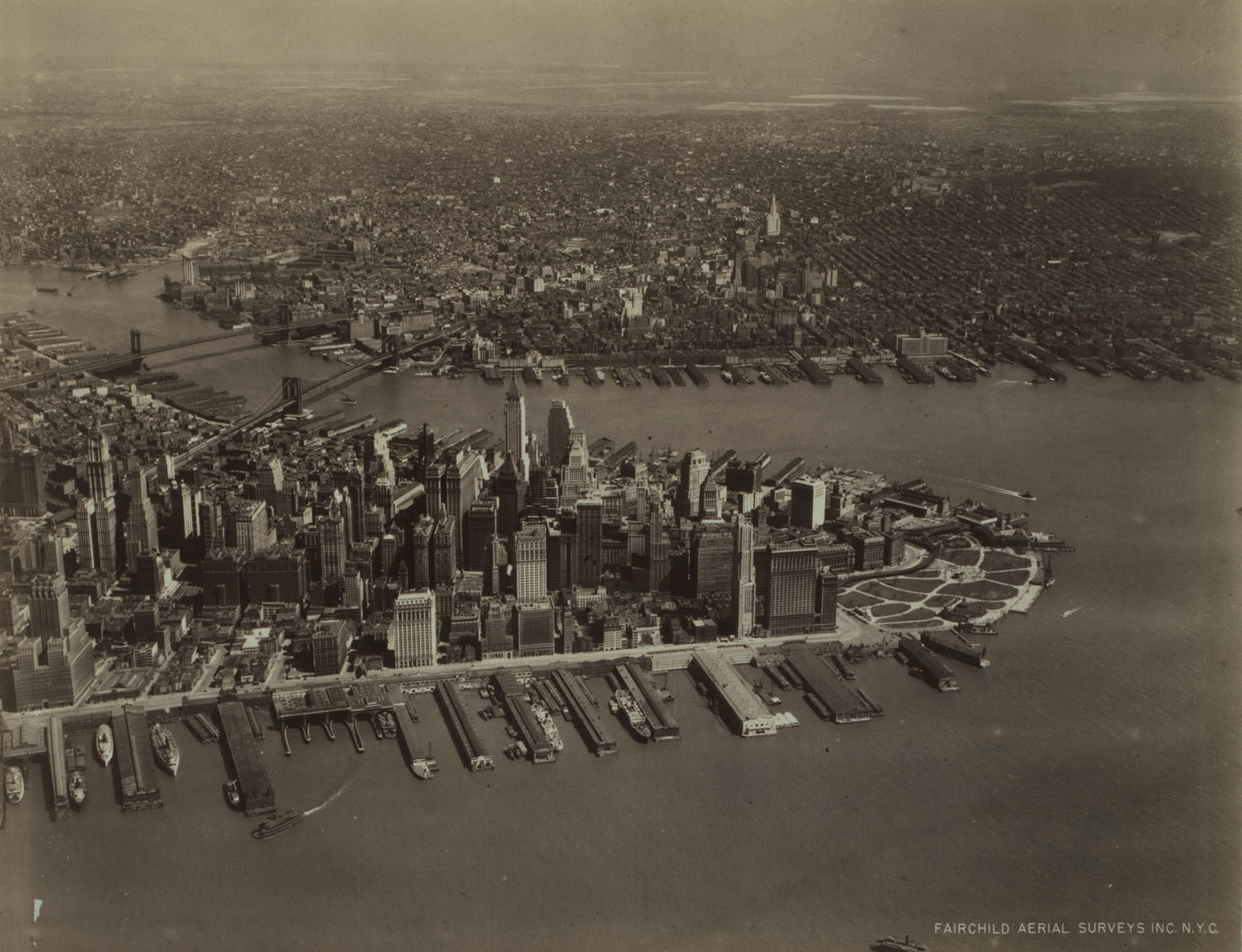
Battery Place and Lower Manhattan from the Air

New York Public Library Digital Gallery

In his lecture "A Poet in New York," Lorca remembers "Battery Place, where sailors and cheap women, soldiers and policemen dance on the tired sea, a pasture for siren-cows, a promenade for bells and bellowing buoys" (Lecture on Poet in New York). Like Grant's Tomb and Riverside Park (with sailors from Navy ships moored in the Hudson), in the 1920s Battery Park was a meeting place and cruising place for the gay world. In New York and especially in Cuba, where he wrote "Ode to Walt Whitman" and wrote El público (The Public), Lorca became more open about his homosexuality.

Battery Park: New York Aquarium

New York Public Library Digital Gallery

"[I felt grateful] for that divine aquarium," Lorca wrote, referring to the massive building in Battery Park at the foot of Broadway. A pamphlet from 1930 identifies the New York Aquarium as "probably the largest of all aquariums, containing a greater number of species and of specimens than any other institution of its kind." ("A Poet in New York")

Bronx Zoo

New York Public Library Digital Gallery

In a lecture on Poet in New York, given in 1932-1934, Lorca remembered the Bronx Zoo, "where I felt like a child and remembered all the children in the world."

Meat Inspection at the Packing House

New York Public Library Digital Gallery

In one of his best-known poems from Poet in New York, "Nueva York: Oficina y denuncia" (New York (Office and Denunciation), Lorca condemns man's indifference to suffering and predatory attitude toward nature, its culture of consumption, and its statistical arrogance.

View Nueva York: Oficina y denuncia

405 Lexington Avenue: Chrysler Building Under Construction, 1929

New York Public Library Digital Gallery

During his nine months in New York, Lorca witnessed the building of some of the city's most remarkable skyscrapers. "Every day they begin a new skyscraper: they are finishing one that is a hundred stories high, a black-and-white building that is truly marvelous" (letter to his family, November 1929). Years later, in his 1932 lecture "A Poet in New York," those buildings seemed beautiful but sinister. "From a distance New York's architecture seems prodigious and, no matter what was intended, moves one as much as a sight of nature, a mountain or a desert. The Chrysler Building defends itself from the sun with its huge silver beak, and bridges, ships, railways, and men seem deafened and chained: chained by a cruel economic system whose throat must soon be cut, and deafened by excessive discipline and because they lack a sufficient dose of madness." (Lecture "A Poet in New York")

Riverside Drive and Palisades: Grant's Tomb

New York Public Library Digital Gallery

In his lecture "A Poet in New York" Lorca remembered his walks along Riverside Drive with friends. "I must thank New York for many things, especially for the holograph blues and the British stamp greens given me by the New Jersey shoreline as I strolled with Anita the Portuguese Indian and Sofía Megwinoff the Russian Puerto Rican..." George Chauncey points out that in the 1920s, Battery Park on the southwest tip of Manhattan, was a popular rendezvous for seafaring men" and that Riverside Park, stretching along the western shore of Manhattan, where ships of all sorts were moored, was also a major cruising area and social center, especially for seamen and their admirers. Two landmarks in the park, Grant's Tomb at 122 St. and the Soldiers and Sailors Monument at 89 Street, were especially renowned as meeting places in the gay world" (Gay New York: Gender, Urban Culture, and the Making of the Gay Male World.)

In Poet in New York, Riverside Drive is the scene not of a gay encounter but of a murder:

View Asesinato (Dos voces de madrugada en Riverside Drive)

320 Second Avenue (Apartment of Dorothy Peterson). Nella Larsen and Dorothy Peterson

Beinecke Rare Book and Manuscript Library, Yale University

Shortly after his arrival in New York, Lorca was introduced to Dorothy Peterson, a Spanish-speaking teacher and theater director who invited him to a party at her apartment on Second Avenue. The African American novelist Nella Larsen, who took him to see Harlem, was also in attendance.

"In the latest party [with Dorothy Peterson and Nella Larsen], the only white person was me. She [Larsen] lives on Second Avenue and from her windows you could see all of New York, aglow. It was night, and long beacons were sweeping back and forth across the sky. The blacks sang and danced. And what marvelous songs! Only cante jondo con compare with them!" (Letter to his family, July 14, 1929).

8 West 70th St.: Shearith Israel Synagogue

Yearbook of the Spanish and Portuguese Congregation Shearith Israel in the City of New York, 1911

Sampling different religious rites and remembering the Jewish legacy of Granada, Lorca paid a visit to Shearith Israel, known as "the Spanish and Portuguese Synagogue," America's first Jewish congregation. "I have also been to a synagogue, of Spanish Jews. They sang the most beautiful things, and the cantor was a true prodigy of voice and of emotion. But I realize that in Granada almost all of us are Jews. It was amazing-- they all looked like they were from Granada . . . What was extraordinary was the singing. The chants were extraordinary, heartrending, disconsolate. It was a continuous, long, and strikingly beautiful lament." (Letter to his family, July 14, 1929)

http://www.shearithisrael.org

4 Beekman Place: home of Mildred Adams

Toward the beginning of August, Lorca's American friend Mildred Adams, a writer for the New York Times, invited him to a party at the apartment where she lived with her aunt, Gertrude Foster Brown, on Beekman Place. He spent the evening as he often did, sharing Spanish folk songs. "It was a party in my honor," FGL writes. "There were a lot of nice Americans. ... Naturally, I had to do my 'Spanish song' number, and I played the guitar and sang soleares with great success. I don't even worry about making a fool of myself, for I have never seen kinder, more innocent... and more intelligent people. The Adams family must have spent a small fortune on the party." (Letter to his family, August 8, 1929)

Russian Orthodox Church of Christ, 15 East 97th St.

Wikimedia Commons

New York offered Lorca his first experience of religious diversity--before the trip to New York he had never left deeply Catholic Spain-- and he went to services in a number of temples, including, perhaps, the Orthodox Cathedral at 15 East 97th.

"The Russian Church is admirable, almost-almost like a Catholic one. . . . But it is extremely beautiful and full of emotion. What are simply amazing are the choirs and hymns. The mass reaches its climax when the 'pope,' after consecrating the host, turns toward the audience, holds up the crucifix, and bursts into a loud lament with a beautiful melody. As theater, they really do it well, these 'popes,' with their long beards and glittering vestments. The ceremony lasted forever-- one has to stand or kneel for over two hours, and they purified me with incense twelve or fifteen times." (Letter to his parents, August 8, 1929)

120 Broadway: Banker's Club, Equitable Building

New York Public Library Digital Gallery

It was Lorca's English friend Colin Hackforth-Jones, whom he had met in Spain and who was now working in New York in a brokerage house, who gave the poet his first glimpse of Wall Street. "We had breakfast on the 32nd floor [of the Equitable Building] with the president of a bank, a charming man with a depth of feline coldness and ancient English reserve. People were coming in after being paid. They were all counting their dollars. Their hands were trembling as they always do when we are counting money. Out the window was the skyline of New York, crowned with great trees of smoke. Colin had five dollars in his pocket, and I had three. And he said in a truly charming way, 'Just think. We are surrounded by millions. And yet the only two real gentlemen here are you and I.' There was a torrent of noise on the street. When we left, I saw a man whose legs had been amputated, pushing himself in a little cart down one of the canyons between the buildings, and, a little way off, a madman talking to himself with a paper hat on his head.. Wall Street and its skyscrapers are truly marvelous." (Letter to his family, second week of August, 1929)

Graf Zeppelin and Statue of Liberty

Private collection

During Lorca's trip to New York, Germany's giant airship, the Graf Zeppelin, flew over Manhattan and embarked from Lakehurst, NJ on a world tour. "Several days ago I saw the Graf Zeppelin anchored beneath [the Wall Street skyscrapers] like a green fish, and for a moment I thought I was dreaming." (Letter to his family, second week of August, 1929)

Graf Zepplin Round-the-World World Flight, 1929

On August 7, 1929, the Graf Zepellin embarked from Lakehurst, New Jersey, on a round-the-world flight sponsored in the U.S. by Hearst newspapers.

1161 Amsterdam Avenue: Casa Italiana, Columbia University

New York Public Library Digital Gallery

At the end of Summer Session, where he studied English in a desultory way, Federico directed Columbia students in a concert of Spanish folk music. "We had the evening of Spanish music, which went pretty well, and I had an important role . . . I directed everything from the piano and it came off with great brio. I wish you could have seen the Americans singing the 'Vito.' It was tremendous!" (Letter to his family, August 22, 1929)

42nd Street and Park Avenue. Grand Central Station

New York Public Library Digital Gallery

In August, after his English classes at Columbia had come to an end, Lorca boarded a train for far northern Vermont to spend his vacation at the lakeside cottage of his friend Philip Cummings in Eden Mills. In Grand Central Station he faced a challenge:

"The day before yesterday, some friends were in Grand Central Station to see me off [to Vermont]. We all had a good laugh, for this was my trial of fire with the English language and my first trip alone through this enormous continent. Grand Station Central [sic] scares anybody . . . but this mechanical country seems to be made for dumb people . . . You couldn't get lost if you wanted to! Everything is full of numbers, signs and gruff but amiable and down-to-earth employees. This was my first trip in an American Pullman (which you have seen in the movies) and which is a miracle of technology and comfort." (Letter to his family, August 22, 1929)

Football Game, South Court, Columbia University

Rare Book and Manuscript Library, Columbia University

From his dormitory room in John Jay Hall in fall 1929, Lorca had a privileged view of the Columbia sports fields and of football players such as the one who comes to life in his play Así que pasen cinco años (When Five Years Pass).

"Just now the Columbia rugby [football] team has come onto the field, dressed in their black and tobacco-colored uniforms. The players are a little like sandpaper and a little like tree trunks, and they are frighteningly strong and seedy-looking. Soon they will crack each other's heads open and no one will care. The same thing holds true for rugby players as for picadors. . . . I love rugby, for besides being typically American, it is so exciting and has such incredible natural beauty that it gives me a lump in my throat." (Letter to his family, c. September 23, 1929)

511 West 114th Street: John Jay Hall, Columbia University

Columbia University Rare Book and Manuscript Library

"I pay a dollar a day for the room. But the room is splendid. Better than one could get for the same price in Spain. Clean towels daily, and they change the bed linens twice a week. . . . This morning they began 'initiating' the new students in my dorm. At nine in the morning I was awakened by the shouting, went to the window, and saw them stripping the initiates--some of them down to their birthday suits. In five minutes there was a huge mound of shoes on the playing field. Two brave souls who put up a fight were seized without mercy and tossed into the basin of a fountain by the door of the library. . . . It was great fun. Just across from me the eighteenth-century statue of Hamilton, about to break into a minuet or a gavotte, is wearing a paper hat and holding a huge broom." (Letter to his family, September 23 or 24, 1929)

107 Waverly Place. Studio of Remo Bufano. Don Quixote

Brander Matthews Dramatic Museum at Columbia University

In fall 1929, García Lorca, María Antonieta Rivas and other friends visited the studio of puppeteer Remo Bufano and admired the enormous figure of Don Quixote made by Bufano for the Town Hall premiere of Manuel de Falla's Retablo de Maese Pedro (1925). No doubt Lorca was thinking about how to stage his own puppet play, Los títeres de Cachiporra, in New York. "...The Billyclub Puppets, translated into English and done with a nice set. There is avant-garde theater here, and it wouldn't be difficult . . . It is the ladies who are taking an interest in all this. In fact, it is the women who do everything in America." (Letter to his family, October 22 or 23, 1929) Lorca's dream of staging his plays in new York would not be realized until 1935 when Irene Lewisohn put on the first English-language version of Bodas de sangre (Blood Wedding) at the Neighborhood Playhouse. Translator Pepe Weissberger titled the play Bitter Oleander.

Philosophy Hall, Columbia University

Private collection

Several important events in Lorca's New York stay transpired in the Lounge of Philosophy Hall, then home to Columbia University's Hispanic Institute, which was under the direction of Federico de Onís. At a ceremony in honor of the Spanish dancer La Argentina (December 10, 1929) Lorca read poems later published in Poem of the Deep Song (1931). On February 10, 1930, he delivered his lecture "Tres modos de poesía" (Three Modes of Poetry), followed by a reception, and ten days later he introduced Ignacio Sánchez Mejías, who gave a talk on bullfighting.

Columbia University

Columbia University Rare Book and Manuscript Library

Lorca liked the feeling of returning from the heat and bustle of downtown to the relative calm of Columbia: "To return to Columbia is like coming home from a foreign country. All is quiet and silence. The grass and the statues of Hamilton and Jefferson soothe me with their color and their revolutionary cassocks from the eighteenth century." (Letter to his family, second week of August, 1929)

At the sun dial at Columbia University with three friends, fall 1929

Fundación Federico García Lorca

Several photos capture Lorca at the Columbia University sundial. The huge granite ball later cracked and was removed, and today only the base remains. " I am sending you a lovely photo taken alongside the sundial of the university. It is an enormous ball of porphyry. If you look at the ball very closely, you can make out a landscape of skyscrapers, and the sun. I think I look pretty good. You can't say I don't send you enough pictures (letter to his family, October 22 or 23, 1929)

At Columbia University with María Antonieta Rivas (to his right) and two friends

Fundación Federico García Lorca

"I'm enclosing a photo of me with María Antonieta Rivas, a Mexican millionaire . . . Also shown are a Hindu ballerina who is very pretty and a Hawaiian pianist who is very good and has been a great success in New York . . . The photo shows Columbia University... You can't see my dormitory, but it's not far away. All the buildings in the photo are part of the university" (letter to his family, first week in November, 1929)

In Chinatown

New York Public Library Digital Gallery

"The other day I got really lost in the city for the first time. I went out to do some errands and took the El. But instead of taking the Sixth Avenue line, I took the Ninth Avenue one, and it took me in the opposite direction to where I was going, a place totally unknown to me. It was a great city of low wooden houses, full of Chinese people and Chinese signs with a deafening music of player pianos and jazz orchestras. Lunch time came and I ate at a Chinese restaurant for 60 cents, a very strange meal, everything cold, but undeniably tasty. The water was a little Chinese boy, ten years old, a little toy, with a little red dress, and he left the plates on the table with the silence almost of a reptile but in an exquisitely aristocratic way." (Letter to his family, October 21, 1929)

Broadway at 49th Street: Rivoli Theater

New York Public Library Digital Gallery

Poster from Welcome Danger, starring Harold Lloyd, a movie Lorca saw in fall 1929 in New York

Lorca's trip to New York coincided with the first talking pictures in Spanish. "I have become a fervent fan of the talking movies, for you can do wonders with them. I would love to make a talking film, and I'm going to try and see what happens. In the talkies is where I learn the most English. Just last night I saw a movie of Harold Lloyd [Welcome Danger] which was delightful.

Driving Around New York City - 1928

In movies with sound you can hear sighs, the wind, all sorts of noises, no matter how small, with true sensibility" (Letter to his family, 22 or 23 October, 1929)

Samuel Gottscho, Times Square at Night, c. 1932

Library of Congress

"Broadway at night was breathtaking: the towering skyscrapers are covered with brightly colored illuminated signs that blink and change with the most unheard-of, marvelous rhythms. Streams of blues and greens and yellows and reds changing and leaping into the sky, higher than the moon, blinking on and off with the names of banks and hotels and automobiles and film companies. The motley crowd of bright sweaters and bold scarves rising and falling in five or six different streams, the horns of the cars together with the shouting and the music from the radios, and brightly lit airplanes passing overhead with ads for hats, clothes, and toothpaste, changing their letters and playing great trumpets and bells. It is a magnificent, moving spectacle put on by the boldest, most modern city in the world." (Letter to his parents, June 28, 1929).

George Washington Bridge. Berenice Abbott, Federal Art Project

New York Public Library Digital Gallery

From the windows of his Columbia dorm room, Lorca could watch the construction of the Hudson River Bridge (later, the George Washington Bridge). "My room in John Jay Hall is wonderful. It is on the twelfth floor of the dormitory, and I can see all the university buildings, the Hudson River, and a distant vista of white and pink skyscrapers. On the right, spanning the horizon, is a great bridge under construction, of incredible grace and strength. The sky is magnificent, and the temperature is perfect. Autumn in New York is probably the loveliest season of the year, as it is everywhere." (FGL, Letter to his family, c. September 21, 1929)

1000 Fifth Avenue: Metropolitan Museum of Art

New York Public Library Digital Gallery

"I spent the entire morning in the [Metropolitan] Museum of New York, which is marvelous, taking notes on virgins painted by the fourteenth-century primitives for my study on Gonzalo de Berceo" (letter to his family, early November, 1929). Only a few notes from that lecture survive.

Aerial view of Columbia University, 1927

Rare Book and Manuscript Library, Columbia University

In winter 1930, having abandoned any hope of learning English, FGL moved out of Columbia University housing and into an apartment at 542 West 112th Street with his friend the law student José Antonio Rubio Sacristán, whose roommate he had been at the Residencia de Estudiantes.

Barnard College. Columbia campus

Columbia University Rare Book and Manuscript Library

In a letter to his family, early December 1929, FGL reports that he has spoken at Barnard College, and a little later, January 22, 1930, he writes of having had dinner there with the orchestral director Enrique Fernández Arbós and "other musical eminences and singers from the Metropolitan Opera."

441 Park Avenue, Apartment of Norma and Hirschel Brickell, Photo of Herschel Brickell

Yazoo (MS.) Public Library

For Lorca, the Park Avenue apartment of Norma and Herschel Brickell--a New York publisher and his beautiful Southern wife-- became a home away from home. It was, Brickell remembered, "a delightful old red-brick apartment house on the corner of Park Avenue and 56th St., where the apartments were huge, sufficiently large for a party of a hundred guests without crowding..." (Brickell, "A Spanish Poet in New York"). Lorca described his friends in a letter of early December 1929 to his parents: "These people, the Brickells, really love me... they are worried that I'm so far away from you and with exquisite courtesy there is no family celebration or weekend that they don't invite me, with the utmost sincerity. These are rich, very influential people and in their home I have met people of great importance in art and literature and finance in New York." (Herschel Brickell, "A Spanish Poet in New York")

60th Street and Columbus: Church of Saint Paul the Apostle

Churchcrawler

On Christmas Eve 1929, Lorca visited his friends Norma and Herschel Brickell at their Park Avenue apartment: "We had a shrine in our house for an alabaster Virgin from Spain, with candles, and afterward Federico went with my wife and some other friends to St. Paul's on the West Side, the Paulist church, which he assured everyone was 'the most beautiful church in the world, and the music too, much better than anything he had ever heard in Spain' (Herschel Brickell, "A Spanish Poet in New York")

300-304 West 59th St. Childs Restaurant at Columbus Circle, 1934

New York Public Library Digital Gallery

García Lorca spent Christmas Eve 1929 with his friends Norma and Herschel Brickell. "After midnight mass, "he was taken to the Columbus Circle Childs for hotcakes and maple syrup, which evoked . . . ecstatic expressions, and he described another Christmas Eve in Spain when he and Maestro [Manuel de] Falla had gone together to a little church somewhere in the hills near Granada, where the nuns danced stately dances before the high altar, playing castanets and tambourines." (Herschel Brickell, "A Spanish Poet in New York")

160 West 44th St. Times Square at Christmas Time, 1929

Private Collection

"Christmas in New York has an extraordinary gaiety; not that it can compare with Christmas in Granada, which has a popular poetic atmosphere unique in all the world.
The popular spectacle is very, very lively. Everywhere one looks—stores, theaters, cafes, façades, store windows, private houses—there are wreaths of mistletoe with red ribbons, to bring good luck. And everywhere there are Christmas trees—in the stations, bookstores, pharmacies, subway … And as if that weren't enough, on Times Square, which is the center of the city, the meeting place of all its electrical madness, mechanical rhythms, grating metal, and incredible tremors—right there, in the middle of the street, they've put up a huge pine tree covered with electric lights and signs wishing Merry Christmas to all the people of New York, and all foreigners, too. The tree is full of loudspeakers playing band music by all the best orchestras. This is a really nice touch—putting a Christmas tree, a symbol of domesticity and intimacy, in the middle of this huge city for those who have no home, no country, no anything. New York is full of these contrasts. There is more bustle on the streets, and you can really tell that Christmas is near." (Letter to his family, thid week of December 1929)

21 Claremont Avenue: Home of Federico and Harriet de Onís

In August 1929, a day or two before leaving New York for a week's vacation in Eden Mills, a tiny village in northern Vermont to which he had been invited by his American friend Philip Cummings, Lorca spent an evening at the Claremont Avenue apartment of his sponsor in New York, Columbia professor Federico de Onís. Singing Spanish folksongs with him were Onís and Ángel del Río and their wives Harriet and Amelia, the journalist Miguel de Zárraga---a correspondent for the Madrid daily ABC--and the novelist Concha Espina, on her way through New York to give a summer course at Middlebury.

123 West 43rd St.: Town Hall. Concert by guitarist Andrés Segovia. Drawing by Hilda Wiener

(Wikipedia)

Andrés Segovia, an old friend from Granada who had collaborated with FGL on a celebrated cante jondo festival in Granada, had taken the city by storm in 1928, a year before FGL's visit, establishing the guitar as a solo instrument, with concerts at Town Hall and elsewhere. In his autobiography, Segovia remembers Lorca: "In New York I saved him a bit from the university environment and I used to take him to more artistic places and to intimate gatherings. He would sit down at the piano and sing Spanish folksongs, and he won everyone's admiration and friendship. He was a year there, more or less, without learning a word of English, and when we got together with people from different countries, mostly Spaniards and Americans, the only thing he would say, with an air of extraordinary geniality, was "Well, as I say, goo-bye!" Once we went to a party with a group of friends, among them a very pretty girl who was about to make her debut in Hollywood and whom we all made a huge fuss about. But it was useless, she didn't pay us the slightest attention. That day, as soon as Federico arrived and met her, they fell into animated conversation. Well, not really, since she didn't speak any Spanish and Federico was allergic to English, never learning a word. But they made themselves understood by signs and gestures. A little later we realized they had disappeared. Where could they be, we asked ourselves? Had they left? And when we went into the next room, they were on the sofa, covered by a blanket which some joker lifted up.... They were joined by... well, affection!

133 East 40th St.: Cosmopolitan Club. Homage to La Argentina

Fundación Federico García Lorca

On February 5, 1930, FGL delivered a talk in honor of the dancer Antonia Mercé, La Argentina before about 30 members of the Cosmopolitan Club, among them New York Times dance critic John Martin, Edith J.R. Isaacs, director of Theater Arts Monthly, Jack Niles, folksingers, and friend José Antonio Rubio Sacristán.

The photo is dedicated to the poet: "García Lorca, keep on telling us, the way you know how to, about our Spain. December 1929."

55 East 76th St.: Apartment of Mildred Adams

New York Public Library Digital Gallery

The Park Avenue apartment of Norma and Herschel Brickell "became an American home where [Federico] could drop in at will. So, with somewhat less success, did the apartment of Ray and Gertrude Brown, respectively artist and musician" (aunt and uncle with whom FGL's friend the journalist Mildred Adams was living.) (Mildred Adams, Garcia Lorca, Playwright and Poet.)

Broadway and West 113th Street: Corn Exchange Trust

Fundación Federico García Lorca

Despite a generous allowance--$100 per month--FGL found himself perpetually short of money. More than once, he reassured his family that he wasn't borrowing from his friends, and that he was "leading a very frugal life... Come to think of it, I don't believe I have asked you for any money beyond the monthly allowance we agreed upon. A hundred dollars isn't much, but my life is very simple. Please don't send more. Well, maybe twenty dollars more per month, but until now I have managed nicely. Besides, I'm going to give some lectures and will use that money to buy what I need... send the money at the beginning of the month directly to the bank where I have my account: Corn Exchange Trust Company, University Branch, Broadway and 113th Street. .. A student can live on less money than anyone else in the U.S. ...We'll see whether my allowance will leave me enough to go to the theater, in which I am greatly interestedLetter to his family, October 21, 1949

823 Greenwich Street: "El Faro" restaurant. A meal with Argentina and Lucrezia Bori

(photo private collection)

Lorca was in New York during what one musician called "the hour of Spanish music." Among musicians capturing the city's imagination in 1929-30 were the guitarist Andrés Segovia, the dancers La Argentina and La Argentinita, and the pianist José Iturbi. "Yesterday I ate with two celebrated Spanish ladies, La Argentina and the singer Lucrecia Bori, one of the idols of New York opera lovers. They are both extremely nice. They treated me and the three of us ate by ourselves in a little restaurant near the Hudson. We drank Anís del Mono and they were happy as could be, but I noticed that they were giving us a substitute, 'Anis del Topo'. I told them that after we were done eating and they made such a stink about it that I thought they were going to come to blows with the owner of the establishment, a wily, amusing Galician." (Letter to his family, end of January 1930; Lorca is probably referring to El Faro restaurant.)

Wall Street, Black Thursday, October 24, 1929

The crash of the stock market in October 1929 deeply affected FGL's vision of America. "A few days ago I had the pleasure (or the horror) of seeing the stock market collapse. As you know, the New York stock market is the stock market of the entire world...Twelve billion dollars were lost! The sight of Wall Street, which I've already told you about (it is the center of the world banking industry), was indescribable. I spent more than seven hours mingling with the crowd when the panic was at its height. I just couldn't leave. Everywhere one looked, there were men shouting and arguing like animals and women crying. Groups of Jews were screaming and wailing on the stairways and on every corner. These were the people who were ruined overnight. The messengers worked so hard running orders that many of them simply collapsed, and no one was able to wake them or get them on their feet. The streets--the terrible canyons between the buildings--were filled with hysteria and chaos, and you cannot possibly imagine the suffering and anguish of the crowd. Obviously the more everyone panicked, the more stock prices fell. At one point the government and the great bankers had to intervene and try to bring everyone to their senses. In the crowd, the screaming, the unbearable hysteria, I found a friend of mine, a woman who came up to me in tears because she had lost everything she had, about fifty-thousand dollars. I tried to console here, as did her other friends. It was the same everywhere--people fainting, cars honking their horns, telephones ringing. Twelve billion dollars were lost. It was simply unbelievable" (letter to his family, first week in November 1929)

43rd and Broadway: Hotel Astor

Drawing by García Lorca, "Young Man and Pyramids", c. 1929, Fundación Federico García Lorca

"When I broke away from that inferno [of the Stock Exchange, on the day of the crash], I found traffic cut off on Sixth Avenue. A banker had thrown himself out the window of his room on the sixteenth floor of the Hotel Astor. I got there just at the moment they were lifting the cadaver. He was a very tall red-haired man, and all I can remember is his huge floury white hands against the gray cement street. (Letter to his family, early November, 1929, though FGL may have confused the hotel with the Roosevelt Hotel, 46th and Madison.)

1929 Stock Market Crash

Gabriel García Maroto, "La Argentina"

From Antonia Mercé, La Argentina. By Ángel del Río, Gabriel García Maroto, Federico García Lorca, and Federico de Onís. New York: Hispanic Institute in the United States, 1930

Literary critic Herschel Brickell recalls "an evening with Federico at a performance by Argentina, Antonia Mercé, the most finished of all the Spanish dancers, a truly great artist... Federico and [his friend Gabriel García-Maroto] talked as freely, unashamedly, and continuously as if they had been in an open-air café, in spite of the vigorous shushings of our neighbors. But they, too, were silent when those marvelous castanets began to chirr and click offstage, always a supreme moment. After the performance, Federico said he wanted to introduce us to his good friend Argentina, who loved him very much, so we all started backstage where there was a crowd. Some policemen tried to stop Federico, and their gestures emphasized their words, but the impetuous young poet could not imagine anyone keeping him from greeting a fellow-Andalusian in New York, so he plowed straight ahead, with the three of us in his wake, until Argentina, wrapped in an old grey woolly bathrobe, saw him at the door."

1 East 42nd Street: Hispano and American Alliance

University of Connecticut Libraries, Thomas J. Dodd Research Center

More than once Lorca visited the luxurious offices of the Hispano and American Alliance Headquartered at 1 East 42nd Street. In August 1929, the Alliance's journal, Alhambra, devoted to Spanish literature and culture, edited by his friends translator and critic Ángel Flores and artist Gabriel García Maroto, published an account of Lorca in New York. "The students at Columbia University, the negro elevator attendants of Furnald Hall, the telephone operator downstairs, al are familiar with the deep bows, the peculiar walk, the pirouettes, the exaggerations and the charm of Federico Lorca. Naturally all this is to defend himself against that universally detested enemy, a foreign language."

Beth Haim Cemetery at St. James Place and Oliver Street near Chatham Square

New York Public Library Digital Gallery

Lorca's poem "Cementerio judío" draws its inspiration from Beth Haim, near Chatham Square, the oldest Jewish burial ground in New York.

"To-day only a small square is left of the original Beth Haim. Peering through the iron fence from the street as the 'L' trains roar by above your head, you may still trace on the crumbling stones the sculptured hands upraised in benediction. Mordecai Gomez is buried there, as is also the Rev. Gershom Mendes Seixas, one oc the early great rabbis of the church..." ("The Remnant of Israel", The World, July 28, 1929)

View From "Cementerio judío" (Jewish Cemetery)

9 East 57th Street: Delphic Studios. Exhibition by Gabriel García Maroto

Photo: García Maroto, "Subway," 1929

One of the friends Lorca re-encountered in New York, was the artist, writer and printer Gabriel García Maroto, who had helped him get his first book, Libro de poemas, into print in Madrid in 1921. Maroto's exhibition of lithographs and paintings, "Magic Spain," opened on November 18, 1929, with FGL probably in attendance, at Alma Reed's Delphic Studios. Reed was also showing works by José Clemente Orozco, then living in New York, who was probably an occasional member of Lorca's group of Mexican friends. "Subway" (1929) is a sample of the work García Maroto did in New York.

Studio of Emilio Amero, 19 West 16th Street

The Greenwich Village studio of Emilio Amero, a young Mexican painter, illustrator and experimental film-maker, was the meeting-place for a tight circle of Lorca's friends.

In fall 1929, Mexican writer María Antonieta Rivas wrote to the painter Manuel Rodríguez Lozano: "Here, with [Emilio] Amero as guide (you can't imagine how good he has been to me), with Pancho Agea, Federico García Lorca, an English kid who is a friend of his [Colin Hackforth-Jones], another Spaniard, the Columbia professor Ángel del Río, and sometimes Maroto and me, we get together and wander about from one place to another. Amero's studio is our meeting place. There, Lorca has read us two of his plays, which are stupendous: Los títeres de Cachiporra and Amor de don Perlimplín con Belisa en su jardín (Aleluya erótica...). (Letter of October 30, 1929) In Amero's studio Lorca gave impromptou concerts of Spanish folk song and wrote his only filmscript, "Trip to the Moon"

107 West 14th St.: Civic Repertory Theater. Scene from The Seagull

L to R: Barbara Bulgakova as Nina Zarechnaia, on the stage, Lewis Leverett as Konstantin Trepl (1929). New York Public Library Digital Gallery

New York served Lorca as a school of the theater. The student theater he saw or heard about in New York may have given him the initial impulse to found his traveling theater troupe La Barraca. He must have been impressed also by a thriving tradition of repertory theater--especially the Civic Repertory Theater directed by Eva La Gallienne--, by the Broadway musical, and by the musical review. It was in New York when he first declared that the Spanish stage was in radical need of change. "I have been writing a play which might prove interesting," he wrote his parents. "One must think of the theater of the future. Everything that now exists in Spain is dead. Either the theater changes radically or it dies away forever. There is no other solution" (letter to his family, August 1929)

203 West 115th Street: New York Public Library. Lecture by Dámaso Alonso

New York Public Library Digital Gallery

On March 2, 1930, The New York Times announced a lecture by Dr. Federico García Lorca on "Contemporary Spanish Poetry" at the People's Institute, 115th Street Branch of the NYPL. But the poet was already on a train to Key West, on his way to Cuba, where he would spend three months giving lectures on poetry and on Spanish music. The lecture was given by his friend Dámaso Alonso.

New York Lunch Counter

New York Public Library "Lunch Hour" Exhibit

The writer Ella Wolfe, who met Lorca through Columbia professor Federico de Onís remembered that after class Onís would take his favorite students and auditors--Lorca, the visiting Spanish writer Julio Camba, the Mexican María Antonieta Rivas, Wolfe and her husband Bertram--for a tertulia in a restaurant close to the Columbia campus and, later, to the Café Royal. In an interview with Miguel Pérez Ferrero, FGL remembers that in New York he would have coffee with Onís, in "those stores [five-and-tens] which are pharmacies where they sell coffee, combs, soap, toothpicks, and sometimes even shoes. We used to sit for hours in those places and have loud discussions, moviendo jaleo, a jaleo which amused people around us. Un jaleo español, someone said on one occasion."

110 Columbia Heights, Brooklyn: Apartment of Hart Crane

Columbia University Rare Book and Manuscript Library

With Ángel Flores, Lorca walked across the Brooklyn Bridge with the intention of meeting the American poet Hart Crane, a fellow admirer of Walt Whitman, who was then working on The Bridge, published in 1930 with photographs by Flores's friend Walker Evans). Flores and García Lorca found a wild party going on, and Flores decided to leave. As he turned to go, he caught a glimpse of "Crane horsing around with a group of sailors, and Lorca with another group around him." The meeting is the subject of a poem by Philip Levine, "On the Meeting of García Lorca and Hart Crane."

277 West 44th Street: Majestic Theater. Encarnación López Júlvez, La Argentinita

Fundación Federico García Lorca

Lorca's friend the dancer Encarnación López Júlvez, La Argentinita, who had played a role in his first play, El maleficio de la mariposa (The Butterfly's Evil Spell), went to New York--together with her lover Ignacio Sánchez Mejías--while the poet was studying there. Lorca must have seen her perform at the Majestic Theater in Lew Leslie's International Revue. The poet also introduced a lecture by the bullfighter Ignacio Sánchez Mejías (subject of his later elegy) at Columbia University in February 1930 and collaborated with La Argentinita on arrangements of a series of Spanish folksongs, recorded after they returned to Spain.